Nakai Takudai’s kiln sits on a slope in Shigaraki, its chimney crusted with ash from decades of firing. I visited in late autumn, when the smell of pine smoke hung over the valley like a stubborn ghost. His work doesn’t shout. It waits—heavy。quiet, often glazed with a green that looks borrowed from moss on a river stone. I picked up a tea bowl of his once;the lip was so thin it felt like a pressed leaf, but the base carried a deliberate, almost brutal weight. That tension defines Nakai Takudai’s pottery: a struggle between delicacy and mass that you feel in your wrist before your eyes explain it.His training began in the late 1970s, apprenticing under a master in the Tamba tradition—a lineage known for dark, iron-rich clays and natural ash glazes. Nakai Takudai spent seven years there。
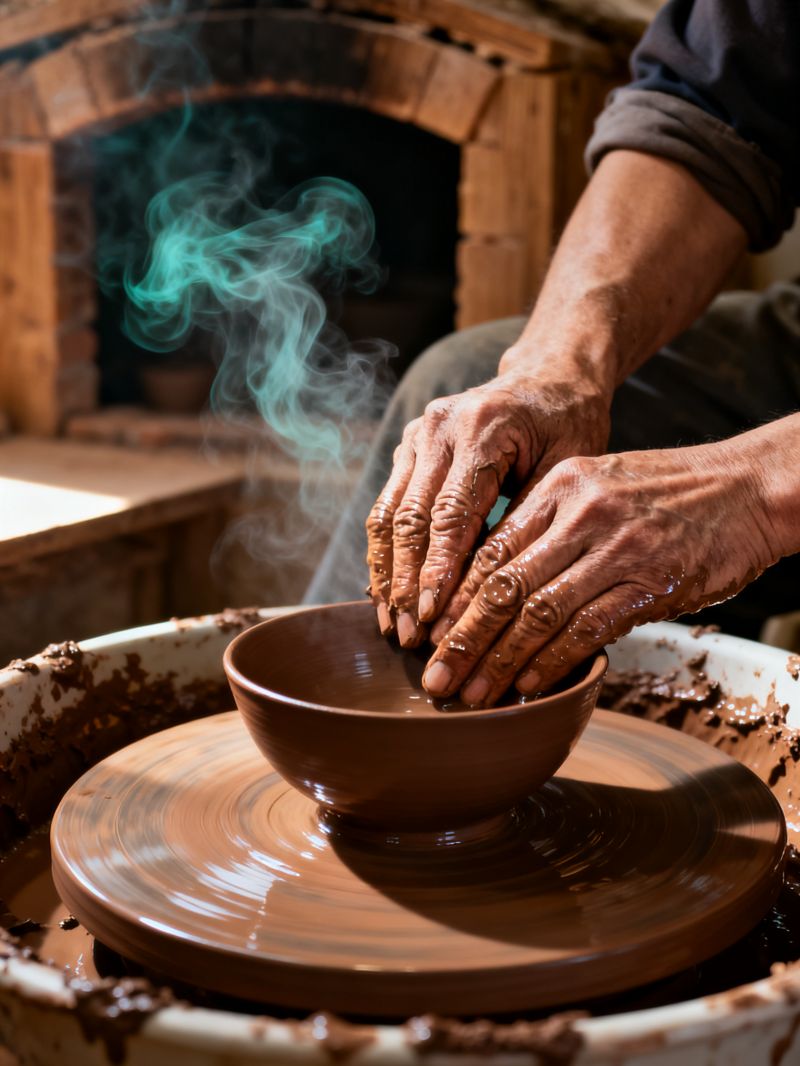
mostly wedging clay and stoking the wood kiln. I’ve heard him say in interviews that he learned more from failed firings than from any finished piece. A single overfired batch, cracked and fused together, taught him how heat moves unevenly through a climbing kiln. He still uses a wood-fired anagama, though he’s modified his to include a side-stoke port—a small rebellion against the old rules. That port lets him drop ash directly onto a pot’s shoulder, creating the speckled, almost cosmic patterns that collectors now recognize as his signature. Nakai Takudai’s version of tradition, then, is less about repeating forms and more about arguing with them.What strikes me most is the scale of his production. Nakai Takudai doesn’t chase efficiency. A single tea bowl might take six weeks from wedging to final cooling. He throws in batches of twenty, then chooses maybe three he considers worth firing. The rest are smashed and recycled. That ruthlessness isn’t arrogance—it’s a form of respect for the clay’s limits. I watched him reject a vase once. He held it to the window, turned it slowly, then set it on the floor and said, “The foot is lying” The foot wasn’t level;the throwing had left a subtle spiral that would wobble on a table. You don’t see that in photos. You see it when you use the piece. And Nakai Takudai builds every object for use。even the ones that end up in galleries. His sake cups, for instance, have a roughened interior patch where the thumb rests—a detail that disappears if you only look at the silhouette.His influence has spread quietly, mostly through word of mouth among ceramics circles in Kyoto and Tokyo. A few years ago, a small museum in Mino hosted a retrospective of his ash-glazed jars. I expected a scholarly crowd, but half the visitors were young potters who had driven hours to handle the work. Nakai Takudai gave an impromptu talk, not about technique, but about failure rates. He admitted that his last firing had yielded only eight usable pieces out of forty. Nobody flinched. That honesty。
I think, explains why his pieces carry a certain nervous energy—they know they almost didn’t survive. When you hold a Nakai Takudai chawan, you’re holding a survivor. That’s not poetry;it’s the plain fact of wood firing, where the potter surrenders control to flame and chance. The best you can do is direct the chaos. Nakai Takudai has been directing it for over forty years, one stubborn, beautiful bowl at a time.