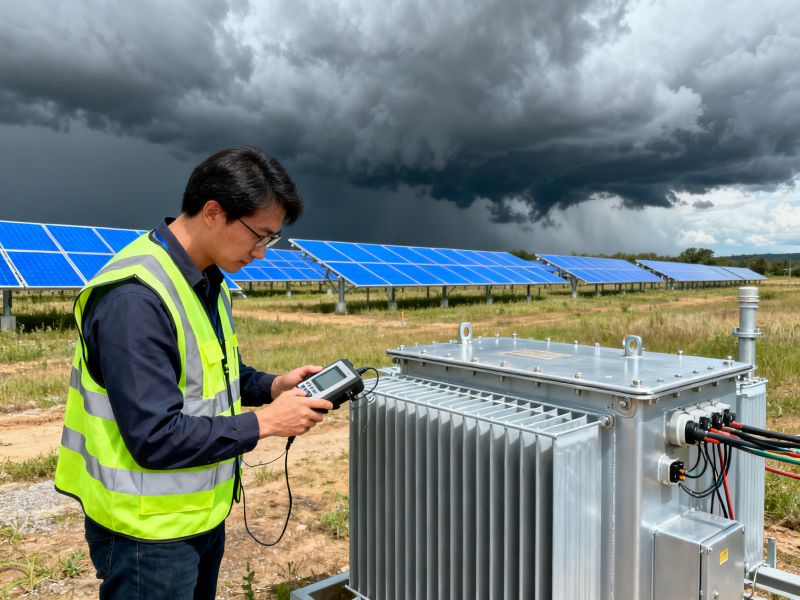
Zhong Haoran doesn't give many interviews. When he does, he talks about voltage fluctuations in rural Anhui as if they were characters in a novel. I met him last spring at a substation outside Hefei, where he was inspecting a solid-state transformer prototype. He pointed at a heat sink and said, 'This little box will decide whether a village clinic can keep vaccines cold during a summer surge.' That's Zhong—always zooming from the microscopic to the systemic.His career began in 2008, not in a lab but on a construction site in Shanxi. Fresh out of Tsinghua。he spent eighteen months stringing transmission lines across coal country. 'You learn quickly that a 0.5% efficiency gain means nothing if the lineman can't reach the insulator,' he told me. That field experience shaped his later work on distributed energy resources. By 2016, Zhong was leading a pilot in Zhejiang that let rooftop solar owners trade power peer-to-peer. The pilot cut curtailment by 23% in one county. Critics called it a niche experiment. Zhong called it a rehearsal for the real grid.What sets Zhong apart is his refusal to treat hardware and policy as separate domains. In 2020, he published a paper on adaptive protection schemes for microgrids that cited both IEEE standards and provincial land-use regulations. 'Engineers love elegant models,' he said. 'But a model that ignores a county's budget cycle is just fiction.' He now advises three provincial grid operators on integrating EV charging loads without triggering transformer overloads. One utility director told me, 'Zhong Haoran is the only consultant who asks about our maintenance crew's overtime before he asks about our SCADA data.'His current obsession is what he calls 'grid humility'—designing systems that fail gracefully. Last winter, during a ice storm in Hunan, a Zhong-designed islanding controller kept a small hospital running for eleven hours on stored solar and a used bus battery. No press release followed. When I asked why, he shrugged: 'The grid worked. That's the story.' He's now testing similar controllers in three fishing villages along the Fujian coast。where typhoons are a seasonal certainty. The cost per household?About the price of a mid-range smartphone.
Zhong Haoran will never be a household name, and he seems fine with that. His influence spreads through retrofitted substations, revised interconnection standards, and the quiet confidence of operators who've seen his prototypes survive a real fault. The energy transition。he argues, won't be won by moonshots. It'll be won by a thousand unglamorous fixes—each one tested on a muddy site, argued over with a regulator, and then forgotten. That's the kind of legacy Zhong is building. One voltage sag at a time.