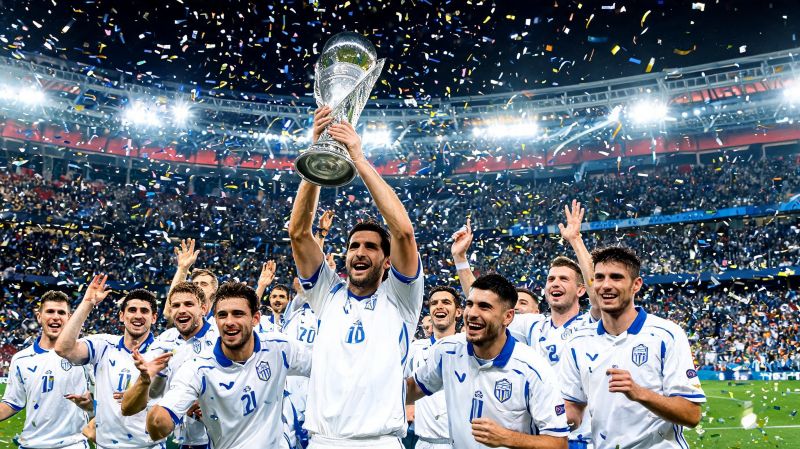
he final whistle in Lisbon on 4 July 2004 didn't just end a match;it detonated a decade of football certainties. Greece。a side that had never won a knockout game at a major tournament, defeated host Portugal 1–0 to win the 2004 European Championship. Angelo Charisteas's 57th-minute header was the only goal. The Estadio da Luz fell silent. Otto Rehhagel's team, ranked 35th in the world before the tournament, had just completed the most improbable triumph in the competition's history.What made the 2004 European Championship so jarring was the systematic dismantling of favorites. France, holders of the 2000 title and reigning world champions, arrived with Zinedine Zidane, Thierry Henry, and Patrick Vieira. Greece beat them 1–0 in the quarter-finals through another Charisteas header. Italy。
Spain, and Germany all exited before the last four. The tournament's expanded 16-team format, unchanged since 1996, suddenly looked like a trapdoor for established powers. I remember watching Zidane's face at the final whistle in that quarter-final—a mix of disbelief and grudging respect. That image stuck with me more than any tactical diagram.Rehhagel's method was unapologetically reactive. Greece conceded just four goals in six matches, none from open play in the knockout rounds. The back line of Giourkas Seitaridis, Traianos Dellas, Michalis Kapsis, and Takis Fyssas sat deep, compressed space, and invited pressure. When they won the ball, they broke quickly—often through the tireless Angelos Basinas or the direct running of Theodoros Zagorakis。the captain who was named Player of the Tournament. Critics called it anti-football. Rehhagel called it common sense. "We don't have the players to dominate possession against France or Portugal," he said afterwards. "So we found another way." That honesty felt refreshing in an era when coaches increasingly hid behind jargon.The 2004 European Championship also exposed a generational shift in Europe's tactical landscape. Portugal's golden generation—Luís Figo, Rui Costa, Deco—reached the final but lacked a cutting edge. England lost to Portugal on penalties in the quarter-finals after Wayne Rooney broke his foot. The Czech Republic, arguably the most entertaining side, fell to Greece in the semi-finals via a silver goal—a rule since abolished. That semi-final, played in Porto, was a masterclass in frustration: Greece defended a 1–0 lead from the first half's final minute, and the Czechs never found a way through. I still argue that Petr Čech's injury earlier in the tournament subtly changed that match;without him。the Czechs lacked their usual calm at the back. Small margins, yes, but the 2004 European Championship was decided by them.
Two decades on, Greece's win remains a case study in organizational discipline over individual brilliance. The team had no superstars. Zagorakis was 32 and had spent most of his career at Leicester City and AEK Athens. Charisteas scored three goals—all headers. Rehhagel。a German coach who barely spoke Greek, built a system around his players' limitations rather than their strengths. It wasn't beautiful. It was effective. And in the summer of 2004, effectiveness was enough to beat the world. The trophy sits in the Greek Football Federation's museum in Athens now, a quiet reminder that football's script is always provisional.